
How Trade Tracker works
Trade Tracker’s assistant isn’t a chatbot bolted onto a dashboard. It’s a production agent system: it reasons over your data, asks before it changes anything, grounds every answer in retrieval over your own notes, and is continuously tested and monitored like any other piece of critical infrastructure. Here’s how it’s built.
The agent
A trading assistant you can trust
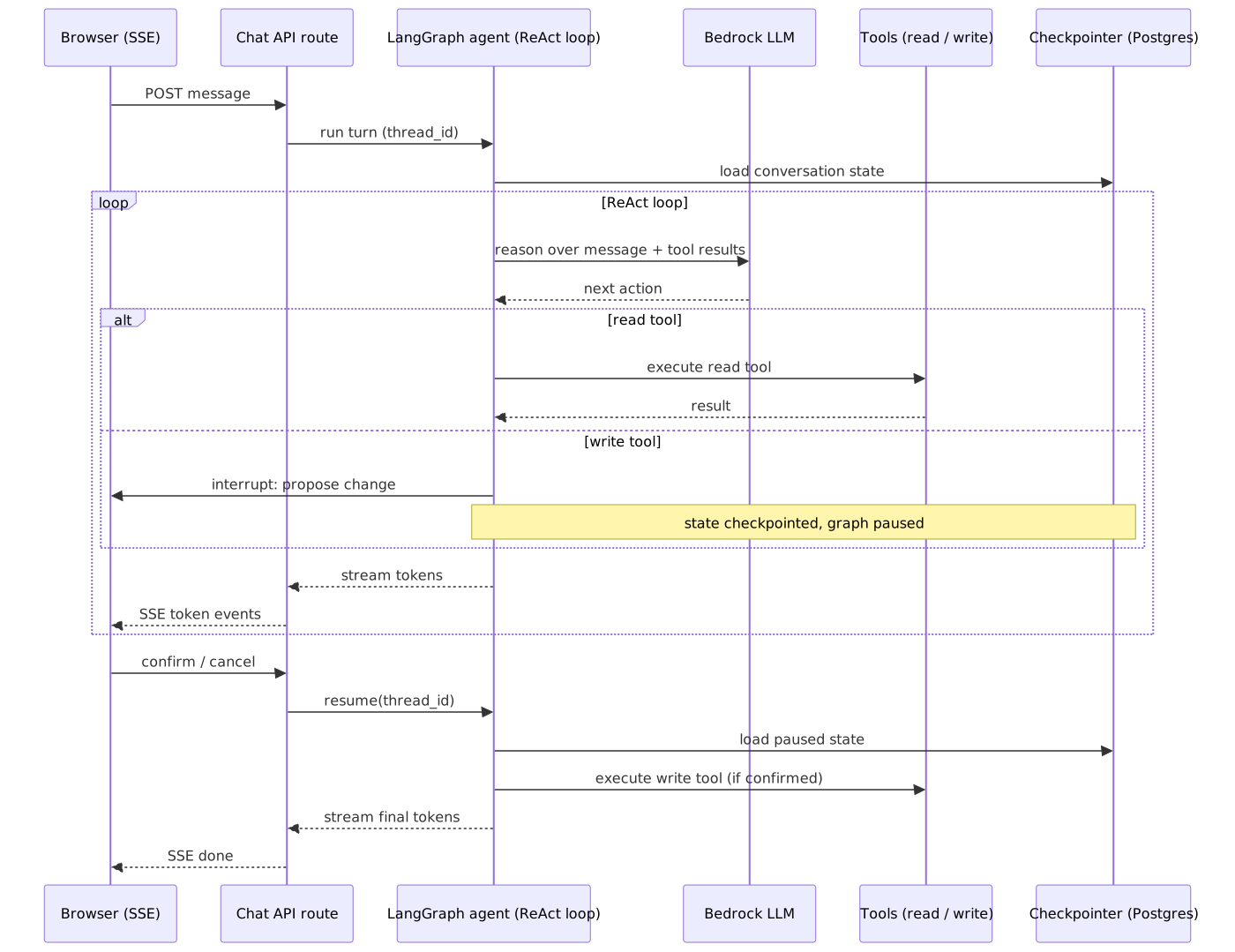
Under the hood, the assistant runs as a LangGraph ReAct agent: an LLM node decides what to do next, and a tools node carries it out, looping until the model has enough information to give you a real answer. Read tools — stats lookups, semantic search over your notes, generated insights — execute immediately, so the agent can pull your actual win rate or a specific losing streak instead of guessing at it.
Responses stream back over Server-Sent Events, token by token, so you see the answer forming rather than staring at a spinner. Conversation state is checkpointed to Postgres on every turn, which matters more than it sounds — the app runs on serverless functions that get recycled between requests, so a long-running conversation has to survive the process that started it disappearing.
Write safety
Every change needs your confirmation
The agent can read your account freely, but it never writes to it silently. Write tools — tagging a trade, editing a note — don’t execute when the model calls them. Instead they raise an interrupt: the graph pauses, and the exact change is proposed to you as a structured, typed diff, not a paragraph of prose describing what it “plans” to do.
Nothing happens until you explicitly confirm or cancel. Because that pause is a real checkpoint in Postgres rather than in-memory state, it survives however long you take to respond — seconds or hours later, the run resumes from exactly where it left off and performs the write only if you approved it. This is the same interrupt-and-resume mechanism shown in the agent loop above; write safety isn’t a prompt instruction that the model could ignore, it’s a hard boundary enforced by the graph itself.
Retrieval
Answers grounded in your data
When the assistant needs context beyond hard numbers — what you wrote in a trade note, or what a generated period review said — it searches for it rather than inventing it. Notes, notebook entries, and reviews are chunked and embedded into a vector index, and every query runs two retrieval strategies in parallel: vector similarity search for semantic meaning, and Postgres full-text search for exact keyword matches. The two ranked lists are merged with Reciprocal Rank Fusion, so a result that scores well on either signal — or both — surfaces near the top.
Retrieval only ever answers the “what did I write” half of a question. The numbers half is handled separately: a deterministic rule engine computes hold time, drawdown, and streak insights directly from structured trade data, with no LLM in the loop. That keeps figures exact and reproducible instead of a model’s best guess at arithmetic, while retrieval supplies the narrative context alongside it.

Reliability
Built to stay reliable
An LLM-powered feature is only as trustworthy as the checks around it. Every change to the agent runs against a fixed evaluation dataset in CI, scored by an LLM-as-judge on three fronts: did it pick the right tool, did it ever attempt a write without proposing it for confirmation, and is the answer actually grounded in retrieved or tool data rather than invented. A regression on any of those three blocks the change.
In production, every agent run is traced end-to-end — the full sequence of reasoning steps, tool calls, and tool results — for debugging and for reviewing eval failures after the fact. Errors, including ones that occur mid-stream while a response is being generated, are captured across both the web app and the background sync worker rather than failing silently.

See it in action
The live demo runs on sample trades — no signup, no broker connection required.
Try the demo